
Some books keep getting answered by every writer who comes after them, and that shelf is what we mean by the best science fiction books of all time. Each pick is tied to the idea it brought into the genre, and each still works for a newcomer today.
Science fiction is a literature of ideas, so we ranked these books by their ideas. Each one introduced or defined a concept the genre still uses: the made creature, the alien invasion, cyberspace, a science of history, a world without fixed sex. We started with more than 30 candidates drawn from award histories, reference works and publisher catalogs. The final 10 were first published between 1818 and 2006. There is one comic novel and one translated novel. The shortest runs 208 pages and the longest 704, so the list holds both a weekend read and a winter project. Every pick also has to work for a newcomer today, not only as a piece of history. Each entry names the idea the book introduced and an edition that is easy to find.
The idea: how large and lasting the book's central concept is, and how often later writers built on it.
Readability today: whether a newcomer can enjoy it now, not only admire it as history.
Range: what it adds that no other pick covers, across eras, countries and tones.
Standing in the genre: major awards, or decades in print and in adaptation.
Our full method, including how we check every book fact against two sources, is on the How We Pick page.
As an Amazon Associate, TenVolumes earns from qualifying purchases.
10. The Hitchhiker's Guide to the Galaxy, by Douglas Adams
Best for: Readers who want to laugh first
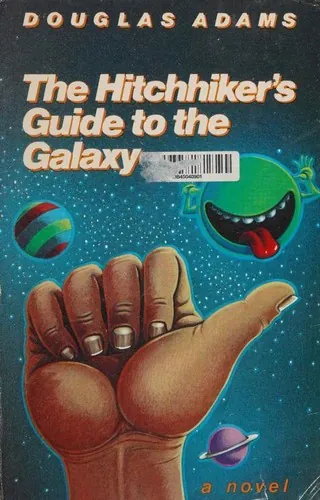
Douglas Adams first told this story on BBC radio in 1978, and the novel followed a year later. Its opening joke is a planning decision. Earth is in the way of a hyperspace bypass, so Earth has to go. Arthur Dent survives only because his friend Ford Prefect is a researcher for the Guide of the title. That cosmic shrug sets the tone for everything after.
The idea it brought to the genre is that science fiction could be openly funny. The size of space is played for laughs instead of awe. Its influence is mostly a matter of tone rather than new concepts, so on a list ranked by ideas it starts at the bottom.
The Del Rey paperback runs 208 pages, the shortest on this list. That makes it an easy book to hand to a friend who says the genre is not for them. If the jokes land, there is more to read: Adams wrote five novels in the series, and Eoin Colfer added a sixth in 2009.
Pages: 208 (Del Rey, 1997 edition)First published: 1979Comic science fictionAdaptation: BBC television series, 1981
9. Parable of the Sower, by Octavia E. Butler
Best for: Readers drawn to near-future fiction
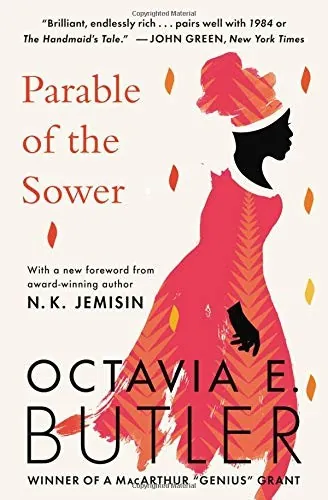
God is Change. That single line is the core of Earthseed, the faith Lauren Olamina builds in the journal that tells this story. Her home is Robledo, a walled neighborhood near Los Angeles, and the story opens in 2024. Outside the walls, climate change and inequality are pulling the country apart. Lauren is hyperempathic, which means she feels what other people feel, a hard gift in a place where people get hurt.
She is just 15 when the journal begins. Octavia E. Butler published the novel in 1993, and its picture of a slow national breakdown has aged in an unsettling way. Most science fiction invents new machines. Butler invented a new faith and asked how people might hold on to one under pressure. Be ready for a grim book. The collapse is already under way on the first page.
The Grand Central paperback runs 368 pages. A sequel, Parable of the Talents, followed in 1998, so plan on two books.
Pages: 368 (Grand Central Publishing, 2019 edition)First published: 1993Science fiction, near future
8. Do Androids Dream of Electric Sheep?, by Philip K. Dick
Best for: Fans of Blade Runner
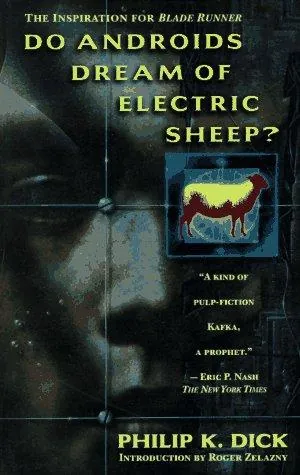
Rick Deckard hunts rogue androids for a living, and he wants the bounty money for a very specific reason. A world war has left most animal species endangered or extinct, owning a live one is a mark of status, and his sheep is electric. Philip K. Dick turns that small, private shame into a novel about what separates a person from a well-made copy.
Its contribution is the artificial being who can pass for human, and the uneasy question of whether the difference matters. Dick published it in 1968. It later inspired Ridley Scott's film Blade Runner in 1982 and the sequel Blade Runner 2049 in 2017.
Readers who know the films should expect a stranger, more domestic book, where a man's pet matters as much as his targets. That question is narrower than the world-sized ideas further up, but it comes in a short package: the Del Rey paperback is just 240 pages.
Pages: 240 (Del Rey, 1996 edition)First published: 1968Science fictionAdaptation: Film Blade Runner, directed by Ridley Scott, 1982
7. The Three-Body Problem, by Cixin Liu
Best for: Readers who like hard science and big mysteries
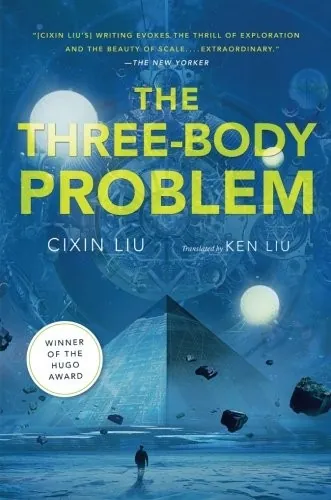
Wang Miao, a researcher in nanomaterials, gets drawn into an investigation, and one clue is a strange virtual reality game called Three Body. The trail leads back decades, to a hidden Mao-era effort to search for intelligent life beyond Earth. In the English edition, those Cultural Revolution scenes come first. Cixin Liu builds the mystery slowly, one odd clue at a time. What the book adds here is range: a first contact story that grows out of Chinese politics rather than an English or American setting.
It is the newest pick on the list, first serialized in 2006, and the only one translated, by Ken Liu. The novel won the Hugo Award for Best Novel in 2015. The early chapters carry a heavy load of physics and politics. The characters are also thinner than the concepts.
The Tor paperback runs 416 pages. It opens a finished trilogy, with The Dark Forest and Death's End to follow, and Netflix adapted it as 3 Body Problem in 2024.
Pages: 416 (Tor, 2016 edition)First published: 2006Science fiction, translated from ChineseAwards: Hugo Award for Best Novel, 2015Adaptation: Netflix series 3 Body Problem, 2024
6. The War of the Worlds, by H. G. Wells
Best for: Readers curious about where invasion stories began
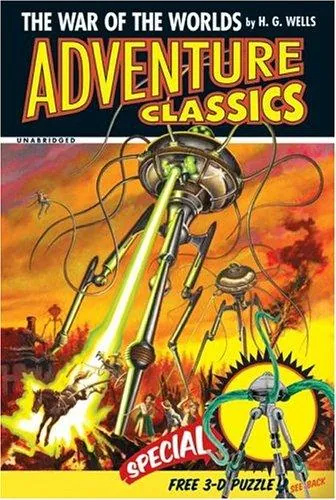
Cylinders fall on the Surrey countryside near Woking, and what climbs out of them has no interest in talking. H. G. Wells arms his Martians with tripod fighting machines and heat-rays, and he tells the whole attack through an unnamed narrator. The book appeared in 1898, after a magazine serial the year before, as one of the earliest stories of an alien invasion of Earth. That template, the hostile visitor from another planet, is its legacy.
Wells had a sharper aim, too. The novel is often read as a critique of Western empire, with Britain on the receiving end for once.
The Penguin Classics edition runs 240 pages, with an introduction by Brian Aldiss and notes by Andy Sawyer. The limit is the narrator, a witness more than a hero, so there is less character to hold on to than in the picks above it. Orson Welles adapted it for radio in 1938, and Steven Spielberg filmed it in 2005.
Pages: 240 (Penguin Classics, 2005 edition)First published: 1898Science fictionAdaptation: Orson Welles radio broadcast, 1938
5. Foundation, by Isaac Asimov
Best for: Readers who enjoy puzzles of politics and strategy
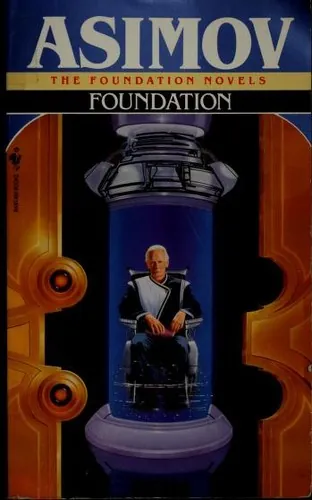
Five linked stories make up this book, and four of them first ran in Astounding between 1942 and 1944. They share one premise. A mathematician, Hari Seldon, has a science called psychohistory that forecasts how huge populations will behave. His numbers say the Galactic Empire will fall and a long dark age will follow, and his plan is to cut that age down to about 1,000 years.
That notion, a future you can work out like a sum, is Isaac Asimov's gift to the genre. His stories jump forward in time, so the cast changes from one section to the next. Readers who want a single hero to follow may feel short-changed. What you get instead is strategy on the scale of centuries.
The book appeared in 1951, and the Foundation series as a whole won the Hugo Award for Best All-Time Series in 1966. The Spectra paperback is 320 pages, and the original trilogy is complete.
Pages: 320 (Spectra, 1991 edition)First published: 1951Science fictionAwards: Hugo Award for Best All-Time Series (Foundation series), 1966
4. Neuromancer, by William Gibson
Best for: Readers who like crime fiction with a hard edge
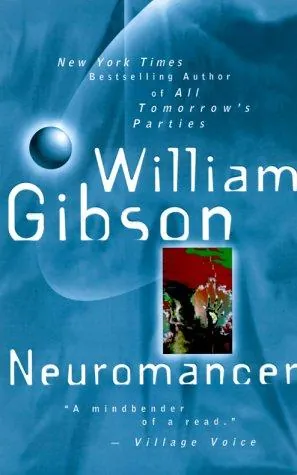
Cyberspace as a worldwide computer matrix that a person can enter is the picture this 1984 novel made popular. It is also the cyberpunk pick on the list. William Gibson's first novel starts in Chiba City, Japan, where a former hacker named Case is getting by on small hustles. A new job would send his mind back into the network he used to work in.
The book won the Hugo, the Nebula and the Philip K. Dick Award, all for a debut. Readability is the hurdle. Gibson drops you into Case's world with little explanation, and the job takes a while to come into focus. Readers who enjoy crime fiction with a hard, fast surface will settle in quickly.
Others may need a few chapters. The Ace paperback is 336 pages, and it opens the Sprawl trilogy, which Count Zero and Mona Lisa Overdrive complete.
Pages: 336 (Ace, 2000 edition)First published: 1984Science fiction, cyberpunkAwards: Hugo Award for Best Novel, 1985; Nebula Award for Best Novel, 1985; Philip K. Dick Award, 1985
3. The Left Hand of Darkness, by Ursula K. Le Guin
Best for: Readers who like ideas about people more than gadgets
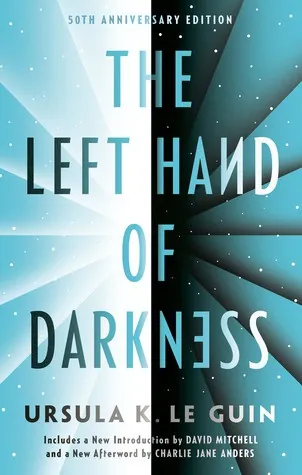
For most of each month, the people of Gethen have no sex at all. Only during a monthly cycle do they take one form or the other. Into this world comes Genly Ai, an envoy from Earth, with an invitation to join an alliance of planets. Gethen is a frozen place, also known as Winter. Ursula K. Le Guin's 1969 novel uses that single biological difference to ask how much of what we call human nature is really habit.
No other pick here handles that idea. The book is framed as Ai's report on his time on the planet, so the early chapters move at the pace of careful observation. Patience pays off. Much of the action becomes a long trek over the ice, and the novel turns into a survival story as well as a thought experiment.
It won both the Hugo and the Nebula. The Ace paperback runs 336 pages and stands on its own.
Pages: 336 (Ace, 2000 edition)First published: 1969Science fictionAwards: Hugo Award for Best Novel, 1970; Nebula Award for Best Novel, 1970
2. Frankenstein, by Mary Shelley
Best for: Readers who want to start at the beginning
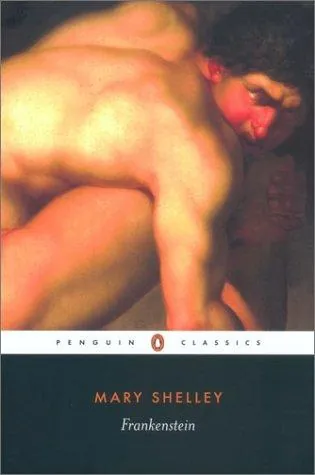
A scientist sets out to build a living being in his laboratory, and he succeeds. Everything else in Mary Shelley's 1818 novel, first published anonymously, follows from that choice. It is the reason this list reaches back more than two centuries. Brian Aldiss argued that Frankenstein is the first true science fiction novel.
Others point to earlier works, such as Kepler's Somnium, and the debate is part of the appeal. Either way, the modern story of a deliberate experiment that creates life starts here. The tale opens with letters from the Arctic explorer Robert Walton, who meets Victor Frankenstein. Later the creature, who has taught himself to speak and read, gives his own account, and that shift is what keeps the book alive for new readers.
Shelley's prose is formal and the pace is unhurried, a real cost for a modern reader. The Penguin Classics edition runs 352 pages and uses the revised 1831 text.
Pages: 352 (Penguin Classics, 2003 edition)First published: 1818Gothic novel, early science fictionAdaptation: Universal film directed by James Whale, 1931
1. Dune, by Frank Herbert
Best for: Readers who want one big book to live in
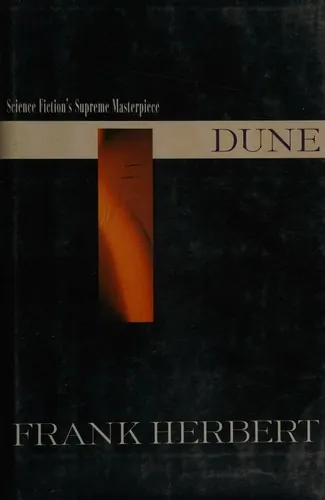
Water is so scarce on Arrakis that its native Fremen live by strict rules of conservation. The rest of the galaxy cares about the planet for a different reason. The spice melange is found nowhere else. Duke Leto Atreides is sent to govern it, and his son Paul comes with him. Frank Herbert's 1965 novel looks like a story of noble houses and betrayal, and it is one.
The world underneath is the bigger achievement. Herbert treated a planet as a working system, and in doing so he put ecology at the front of science fiction. That idea is why the book still feels current. Dune won the first Nebula Award for Best Novel and shared the Hugo Award the same year. Length is the cost.
The Ace paperback runs 704 pages, by far the longest book here, and it first ran as a serial in Analog. David Lynch filmed it in 1984 and Denis Villeneuve in 2021. Herbert wrote five sequels.
Pages: 704 (Ace, 2005 edition)First published: 1965Science fictionAwards: Hugo Award for Best Novel (tie), 1966; Nebula Award for Best Novel, 1966Adaptation: Film directed by David Lynch, 1984
| Rank | Title | Author | Year | Pages | Best for |
|---|---|---|---|---|---|
| 1 | Dune | Frank Herbert | 1965 | 704 | Readers who want one big book to live in |
| 2 | Frankenstein | Mary Shelley | 1818 | 352 | Readers who want to start at the beginning |
| 3 | The Left Hand of Darkness | Ursula K. Le Guin | 1969 | 336 | Readers who like ideas about people more than gadgets |
| 4 | Neuromancer | William Gibson | 1984 | 336 | Readers who like crime fiction with a hard edge |
| 5 | Foundation | Isaac Asimov | 1951 | 320 | Readers who enjoy puzzles of politics and strategy |
| 6 | The War of the Worlds | H. G. Wells | 1898 | 240 | Readers curious about where invasion stories began |
| 7 | The Three-Body Problem | Cixin Liu | 2006 | 416 | Readers who like hard science and big mysteries |
| 8 | Do Androids Dream of Electric Sheep? | Philip K. Dick | 1968 | 240 | Fans of Blade Runner |
| 9 | Parable of the Sower | Octavia E. Butler | 1993 | 368 | Readers drawn to near-future fiction |
| 10 | The Hitchhiker's Guide to the Galaxy | Douglas Adams | 1979 | 208 | Readers who want to laugh first |
Frequently asked questions
What are the best science fiction books of all time?
Our list is led by Dune by Frank Herbert, first published in 1965. It won the first Nebula Award for Best Novel and shared the Hugo Award, and it treats an entire planet as a living system. Frankenstein is a close second for readers who want the genre's starting point.
What is a good first classic science fiction book?
Start with The Hitchhiker's Guide to the Galaxy or Do Androids Dream of Electric Sheep? Both are short, at 208 and 240 pages in the editions we list. If you want something more serious, Foundation is 320 pages and reads as a series of linked stories.
Do I need to read the sequels to these books?
No. Each pick on this list works as a single book. Dune, Foundation, Neuromancer and The Three-Body Problem all begin longer series, and Parable of the Sower has one sequel, but you can stop after the first volume.
How did we choose these science fiction books?
We scored more than 30 candidates on four points. They were the size of the central idea, how well the book reads today, what it adds, and its standing in the genre. Facts such as awards and page counts were checked against at least two independent sources.