
A real teenage point of view was the first thing we looked for in the best YA books, the young adult novels that shaped the category. Every pick still reads well for a teen or an adult meeting it cold, and each entry flags the hard subjects inside.
Young adult fiction has a short history and a crowded shelf. This list picks 10 books that shaped what YA can be, across five decades, from 1967 to 2017. It is written for two kinds of readers: teens choosing what to read next, and adults who missed these books the first time or want to see what the fuss is about. Every pick is told by or close to a teenager, with stakes a teenager would recognize. Influence counted heavily, whether through awards such as the Printz and the Newbery, decades in print, or the books that followed. Lengths run from 224 to 608 pages, and each entry gives the page count of an in-print edition. We give the publisher's suggested age where two sources agree on it. Each paragraph also names the hard subjects a book takes on, so nothing catches you off guard.
Influence: major awards such as the Printz, Newbery or Morris, decades in print, or a clear line of books that followed it.
Teen point of view: the story is told by or close to a teenager, and the stakes are ones a teenager would recognize.
Reads well now: the book still works for a first-time reader today, whether that reader is 14 or 40.
Range: different decades, genres and voices, with one book per author.
Our full method, including how we check every book fact against two sources, is on the How We Pick page.
As an Amazon Associate, TenVolumes earns from qualifying purchases.
10. Six of Crows, by Leigh Bardugo
Best for: A fantasy heist with a crew of narrators
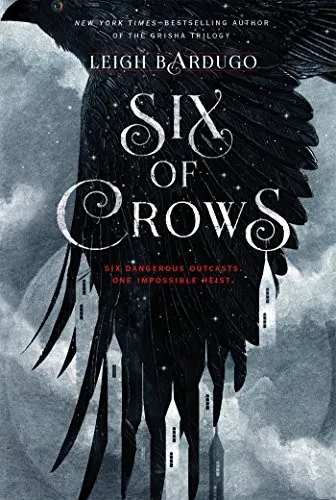
Kaz Brekker leads a crew of thieves in Ketterdam, a port city that Leigh Bardugo loosely modeled on Amsterdam in the age of the Dutch Republic. He takes a job that sounds close to impossible: break into the Ice Court, a military stronghold in Fjerda, and get out alive. The story passes among five narrators, so you see the plan through several members of the crew. That rotating cast shows how far YA fantasy can move from the lone hero with a destiny.
Nobody here is chosen. Everyone is hired. There is a practical catch: this is half of a story, and Crooked Kingdom (2016) completes the duology. Keep the second book close. The novel is set in the wider Grishaverse, though the earlier Shadow and Bone trilogy is not required reading. Netflix brought these characters into its Shadow and Bone series in 2021, with a storyline written for television.
Pages: 496 (Square Fish, 2018 edition)First published: 2015Young adult fantasyAdaptation: Characters adapted in Netflix's Shadow and Bone, 2021
9. The Fault in Our Stars, by John Green
Best for: A love story that faces illness head-on
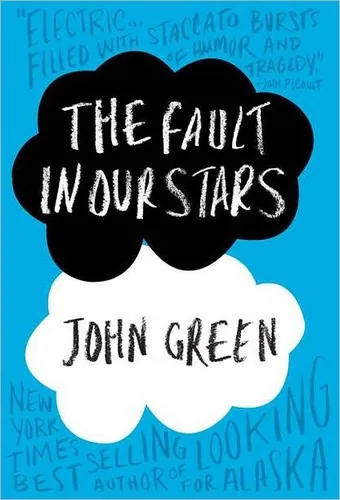
Hazel is 16, her cancer is terminal, and she narrates this novel herself. A drug has shrunk her tumors, but nobody mistakes that for a cure. She meets Augustus Waters at a cancer support meeting, and John Green never lets you forget why either of them is in that room.
What carries the book is Hazel's voice, funny and blunt, which keeps the talk about death honest without turning it into a lecture. Its publisher suggests it for readers 14 and up, and a film followed in 2014. The two leads speak in polished, quotable lines that can sound older than their years.
Know going in that grief is the subject, not a subplot. Readers who want a contemporary love story with real weight, and who are ready for a sad one, will find it in 352 pages from Penguin.
Pages: 352 (Penguin Books, 2014 edition)First published: 2012Young adult fiction, romanceAdaptation: Film, 2014
8. Eleanor & Park, by Rainbow Rowell
Best for: A first-love story told from both sides
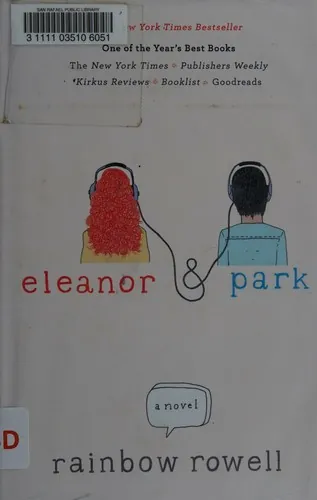
Comics come first, then mixtapes. That is how two 16-year-olds in Omaha get to know each other, after Eleanor ends up beside Park on the school bus on her first day. The year is 1986, and neither of them fits in anywhere. Rainbow Rowell alternates chapters between the two, so you see the same small moments land on both sides.
Few YA romances let both people be this awkward and this unsure of what they deserve. The book won the Boston Globe-Horn Book Award for Fiction in 2013 and a Printz Honor in 2014. It is also a quiet book.
The plot builds slowly, and much of it happens in glances and headphones. Readers who want first love without vampires, illness or the end of the world will find it in these 336 pages, set over a single school year.
Pages: 336 (St. Martin's Griffin, 2013 edition)First published: 2012Young adult fiction, romanceAwards: Michael L. Printz Honor, 2014; Boston Globe-Horn Book Award for Fiction, 2013
7. The Giver, by Lois Lowry
Best for: A short, quiet dystopia for younger teens
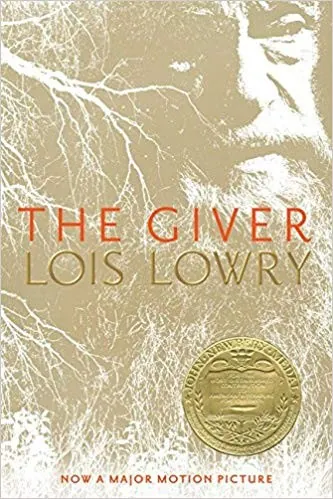
Jonas lives in a calm, orderly community where nobody remembers the past. At the Ceremony of Twelve, he is singled out for something unusual. He will train with the Giver, the one person who holds the community's memories. Lois Lowry lets the missing pieces of this world appear slowly, and color is one of them.
The novel came out in 1993, 15 years before The Hunger Games, and asks a similar question in a much softer voice: what does a perfect society cost? It won the Newbery Medal in 1994. It is also the gentlest book here, and older teens may want more texture than its 240 pages offer. It opens the Giver Quartet, yet it reads well on its own. A 2014 film exists. For a reader around 12 who is ready for an idea that lingers, this is the right first dystopia.
Pages: 240 (HMH Books for Young Readers, 2014 edition)First published: 1993Young adult fiction, dystopianAwards: Newbery Medal, 1994Adaptation: Film, 2014
6. Monster, by Walter Dean Myers
Best for: A courtroom drama told as a screenplay
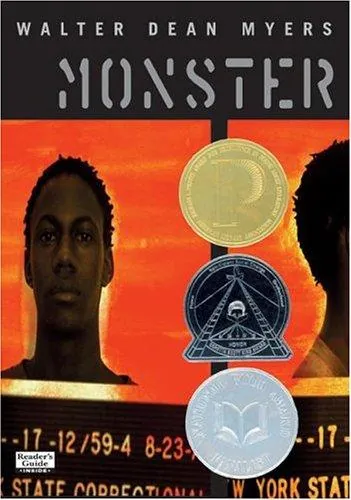
Steve Harmon is 16 and on trial in New York as an accomplice to a murder. Through the trial and the nights in jail, he writes it all down as a film script, broken up by pages from his journal. Walter Dean Myers uses that format to put a hard question in your hands. Who is Steve, really?
You hear each witness, read the script he writes about himself, and have to decide what you believe. Monster won the Michael L. Printz Award in 2000 and was a National Book Award finalist in 1999, and its form still looks bold on a YA shelf. The script layout takes a few pages to settle into, and not every reader will warm to it. Those who do get one of the most original structures in the category.
A film version premiered in 2018 and reached Netflix in 2021. At 281 pages it suits readers who like courtroom drama and books that leave the final judgment to them.
Pages: 281 (HarperTempest/Amistad, 2004 edition)First published: 1999Young adult fiction, legal dramaAwards: Michael L. Printz Award, 2000; National Book Award for Young People's Literature finalist, 1999Adaptation: Film, 2018 (on Netflix from 2021)
5. The Book Thief, by Markus Zusak
Best for: A long historical novel narrated by Death
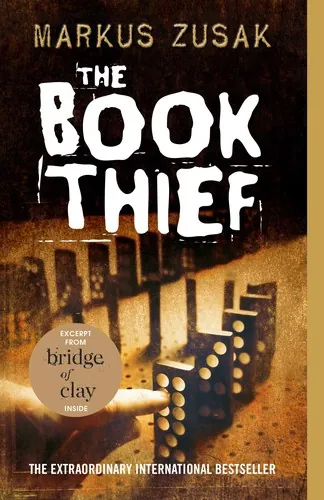
Stolen books are both theft and comfort in this novel, and a girl named Liesel Meminger keeps taking them. From 1939 she lives with a couple who have taken her in, in a town near Munich in Nazi Germany. The husband, who plays the accordion, teaches her to read. Later the words become something she gives away, to neighbors crowded together while bombs fall and to a Jewish man the family keeps hidden under the house.
The narrator is Death, which tells you something about the stakes. Markus Zusak published it in 2005, under a young readers' imprint in the United States, and it won a Printz Honor in 2007. It shows how much a teen novel can carry: war, guilt and the power of words, all seen at a child's height. Size is the caveat.
At 608 pages the paperback is the longest here, and the war takes a heavy toll. A 2013 film covers the plot, but Death's watchful voice is the reason to read the book.
Pages: 608 (Knopf Books for Young Readers, 2007 edition)First published: 2005Young adult fiction, historicalAwards: Michael L. Printz Honor, 2007Adaptation: Film, 2013
4. The Hate U Give, by Angie Thomas
Best for: A contemporary novel about speaking up
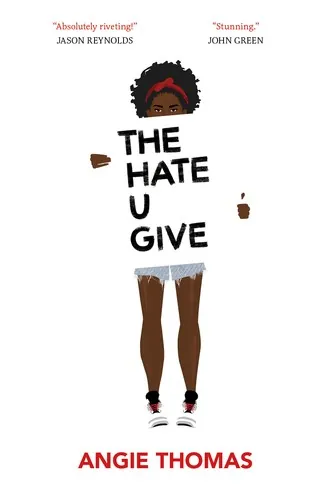
Angie Thomas hands a story from the news to a teenage narrator, and that choice shapes everything here. Starr Carter is 16. Home for her is Garden Heights, a poor Black neighborhood. Her school, Williamson Prep, is mostly white. Early on, a traffic stop turns deadly in front of her.
Khalil, whom she has known since they were small, dies at the hands of a white officer. The rest of the novel asks what a witness her age should say, and how loudly. Because a teenager tells it, the book never reads like an essay. It was Thomas's first novel. In 2018 it won the William C. Morris Award for a debut, along with a Printz Honor and a Coretta Scott King Author Honor, and a film came out the same year.
Grief and police violence sit at the center of all 464 pages. Readers who want a contemporary story about finding a public voice should read this one next.
Pages: 464 (Balzer + Bray, 2017 edition)First published: 2017Young adult fiction, contemporaryAwards: William C. Morris Award, 2018; Michael L. Printz Honor, 2018; Coretta Scott King Author Honor, 2018Adaptation: Film, 2018
3. Speak, by Laurie Halse Anderson
Best for: A frank novel about trauma and finding a voice
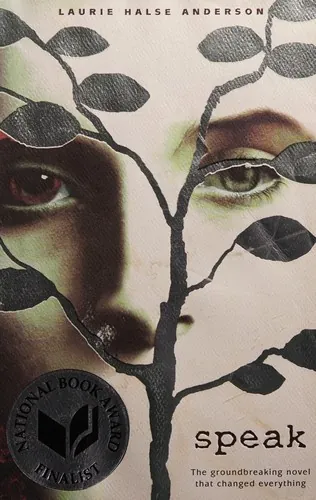
Told in Melinda's own voice across one school year, Speak is about a silence and where it comes from. The year is her first at Merryweather High. Before classes even start, the other students have turned on her, because she phoned the police during a party at the end of the summer. She says less and less as the months pass. The art room becomes the one place she can think.
Laurie Halse Anderson lets the cause come out slowly, though the publisher's own description names it: an upperclassman raped her. Nothing is shown graphically. That frankness gives teenagers words for something many books only hint at. It was a National Book Award finalist in 1999 and a Printz Honor book in 2000. Kristen Stewart starred in a 2004 film, and a graphic novel version also exists.
At 224 pages it can be read in a weekend. For a reader who has been through something similar, an adult nearby to talk with can help.
Pages: 224 (Square Fish, 2011 edition)First published: 1999Young adult fiction, contemporaryAwards: Michael L. Printz Honor, 2000; National Book Award for Young People's Literature finalist, 1999Adaptation: Film starring Kristen Stewart, 2004
2. The Hunger Games, by Suzanne Collins
Best for: A fast dystopian thriller with a practical heroine
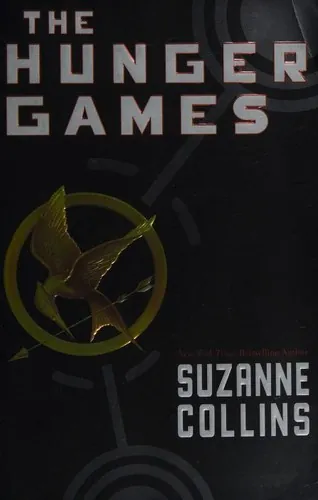
Katniss Everdeen volunteers. That single choice, made at 16 to spare her younger sister, starts everything in Suzanne Collins's novel. The contest she enters is drawn by lottery each year across Panem's 12 districts, with a boy and a girl taken from each. Only one is meant to come out alive, and cameras carry it to the whole country. Collins writes it at a sprint.
Few YA novels pair a premise this simple with a heroine this practical, and that pairing makes it easy to hand to almost any teen. Nobody prophesied Katniss. She chose this, and now she has to stay alive while the nation watches. The broadcast also raises a hard question about who pays for other people's entertainment. Catching Fire (2009) and Mockingjay (2010) complete the original trilogy, and a 2012 film followed.
Scholastic flags its mature themes, and the violence among young people is the point of the story, not a side effect. The 384-page paperback moves fast enough for readers who usually stall halfway through a book.
Pages: 384 (Scholastic, 2010 edition)First published: 2008Young adult fiction, dystopianAdaptation: Film, 2012
1. The Outsiders, by S. E. Hinton
Best for: A short first step into YA
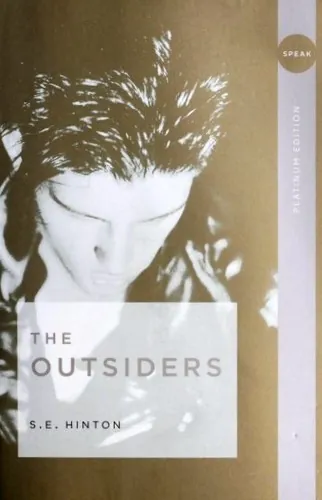
S. E. Hinton was 16 when she wrote this novel, and you can hear it on every page. Her narrator, Ponyboy Curtis, is a 14-year-old greaser, which in his world means poor and always on guard. The Socs come from money, and the two gangs keep colliding. That teenage voice is why it tops this list. It talks straight to you about fights and friendship and class, with nobody older smoothing the edges.
The idea that teenagers deserve books in their own voice runs through everything else on this list. Early on, a clash with the Socs ends in a death at Johnny's hand, and everything after grows from it. The publisher suggests it for ages 12 and up, and at 224 pages it is the easiest entry point here. Francis Ford Coppola filmed it in 1983, and a Broadway musical version won the Tony Award for Best Musical in 2024. The slang ties it to the 1960s, and that is the main caveat. The feelings have not aged at all.
Pages: 224 (Speak, 2006 edition)First published: 1967Young adult fiction, coming-of-ageAdaptation: Film directed by Francis Ford Coppola, 1983; Broadway musical, 2024
| Rank | Title | Author | Year | Pages | Best for |
|---|---|---|---|---|---|
| 1 | The Outsiders | S. E. Hinton | 1967 | 224 | A short first step into YA |
| 2 | The Hunger Games | Suzanne Collins | 2008 | 384 | A fast dystopian thriller with a practical heroine |
| 3 | Speak | Laurie Halse Anderson | 1999 | 224 | A frank novel about trauma and finding a voice |
| 4 | The Hate U Give | Angie Thomas | 2017 | 464 | A contemporary novel about speaking up |
| 5 | The Book Thief | Markus Zusak | 2005 | 608 | A long historical novel narrated by Death |
| 6 | Monster | Walter Dean Myers | 1999 | 281 | A courtroom drama told as a screenplay |
| 7 | The Giver | Lois Lowry | 1993 | 240 | A short, quiet dystopia for younger teens |
| 8 | Eleanor & Park | Rainbow Rowell | 2012 | 336 | A first-love story told from both sides |
| 9 | The Fault in Our Stars | John Green | 2012 | 352 | A love story that faces illness head-on |
| 10 | Six of Crows | Leigh Bardugo | 2015 | 496 | A fantasy heist with a crew of narrators |
Frequently asked questions
What are the best YA books to read first?
Start with The Outsiders or The Giver. Both are short, at 224 and 240 pages in the editions listed here, and neither needs any background in the genre. If you want something longer and faster, The Hunger Games is the natural next step.
Are these young adult books good for adults?
Yes. Every book here was chosen partly for how well it reads today for a first-time reader of any age. Adults who like literary fiction may want to begin with The Book Thief, which is narrated by Death and set in Nazi Germany.
What age are YA books for?
Publishers set their own age ranges, and they vary by book. Penguin Random House suggests The Outsiders for ages 12 and up and The Fault in Our Stars for ages 14 and up. Speak, The Hate U Give and The Hunger Games deal with rape, police violence and killing, so read each entry before handing a book to a younger reader.
Which of these YA books have been made into movies?
Eight of the 10 have been filmed. The Outsiders became a 1983 film by Francis Ford Coppola, and The Hunger Games reached cinemas in 2012. The Fault in Our Stars and The Giver were both filmed in 2014, and The Hate U Give followed in 2018.
Sources
- American Library Association: Michael L. Printz winners and honor books
- American Library Association: The Hate U Give wins the 2018 William C. Morris Award
- Penguin Random House: The Outsiders by S. E. Hinton
- National Book Foundation: Monster by Walter Dean Myers, 1999 finalist
- Open Library: edition records for the books on this list